How to Choose Water Soluble Nitrogen Rich Fertilizer
Choosing the right Water Soluble Nitrogen Rich Fertilizer requires more than selecting the highest nitrogen percentage. Crop type, growth stage, soil condition, irrigation method, and local water quality all influence performance. A leafy vegetable may need steady nitrogen during canopy development, while flowering crops can suffer from excessive vegetative growth. The product must match the crop’s actual needs.
Begin with a soil or substrate test. It can reveal available nitrogen, pH, salinity, and nutrient imbalances. Then read the fertilizer label carefully. Check the nitrogen forms, such as nitrate, ammonium, and urea. Their release behavior differs, especially in cool soil or frequent fertigation systems. Solubility also matters. A product that leaves crystals in a mixing tank may clog emitters and create uneven feeding.
Small details often decide the result. Use clean water, measure accurately, and dissolve the fertilizer completely before application. Test the solution in a small container first. Keep simple records of application rates, crop color, leaf growth, and weather conditions. These observations support better decisions than appearance alone.
There is no universal best formula. That is easy to forget. Excess nitrogen can weaken stems, delay maturity, increase runoff risk, and reduce product quality. Underfeeding can cause pale leaves and slow development. Agricultural advisers, laboratory reports, and manufacturer instructions provide useful guidance, but field conditions still require judgment. A careful choice balances nutrient concentration, solubility, crop timing, environmental responsibility, and practical handling. Sometimes, the most expensive product is not the most suitable one.
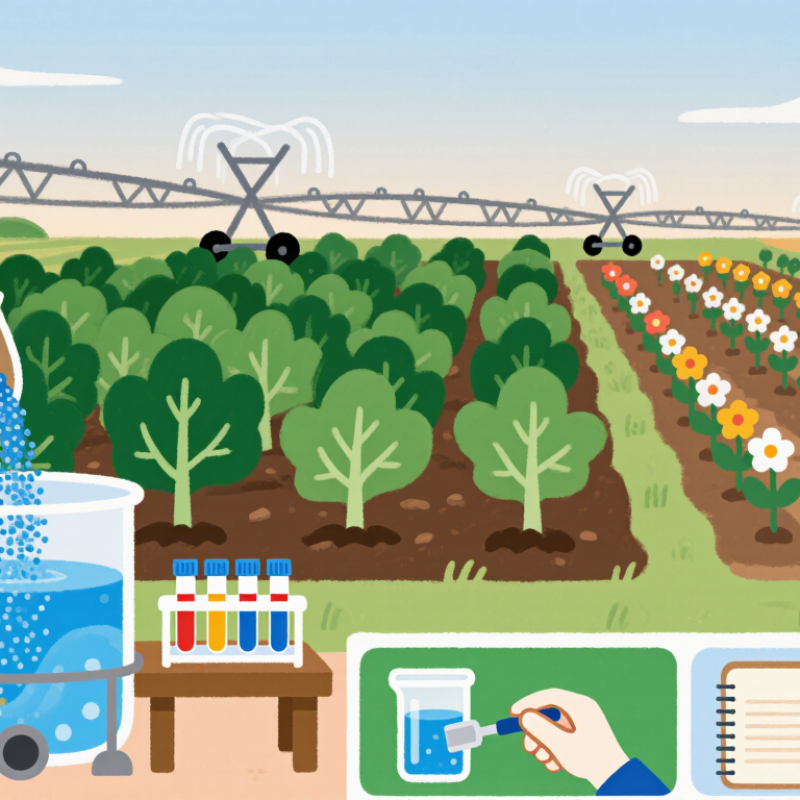
Define Crop Demand with Soil Tests and a Target in kg N/ha
How to Choose Water Soluble Nitrogen Rich Fertilizer
A reliable nitrogen rate begins with measurement, not a product label. Collect 15–20 cores from the top 30 centimetres, avoiding headlands and manure piles. Test nitrate-N, ammonium-N, organic matter, pH, and electrical conductivity. A single sample can mislead. Soil changes quickly after rain, irrigation, or cultivation.
Set a crop target in kilograms of N per hectare. For example, a wheat crop may require 180 kg N/ha for a specific yield goal, but the soil test may show 55 kg available N/ha. Then credit 25 kg N/ha from manure or compost. If expected fertilizer efficiency is 70%, the calculation becomes (180 − 55 − 25) ÷ 0.70, or about 143 kg N/ha. The number is not perfect. It is a managed estimate.
Split that target around crop demand. Apply smaller doses during rapid leaf growth, flowering, or fruit filling, rather than one heavy application. Water-soluble nitrogen supports fertigation and quick correction, but soluble does not mean risk-free. The FAO’s World Fertilizer Trends and Outlook to 2026 projected global nitrogen demand at roughly 109 million tonnes in 2022/23. This scale makes efficiency important. The IPCC’s Sixth Assessment Report also identifies agricultural nitrogen management as a major pathway for reducing nitrous oxide emissions. Re-test after irrigation or heavy rainfall. Conditions change. Your original target may need revision.
Read N–P–K Labels: Urea Has 46% N; Calcium Nitrate Has 15.5%
Choosing a water-soluble nitrogen fertilizer starts with reading the N–P–K label, not the product name. The first number shows nitrogen percentage by weight. Urea contains 46% N, so a 10-kilogram bag supplies about 4.6 kilograms of nitrogen. Calcium nitrate contains 15.5% N, providing about 1.55 kilograms in the same bag. Numbers matter.
In greenhouse work, I compare concentration with crop demand and application volume. Urea delivers more nitrogen per kilogram, which can reduce storage and transport needs. However, it must convert before plants can use much of its nitrogen. Calcium nitrate supplies readily available nitrate nitrogen and also adds calcium. That combination can suit leafy crops and fast-growing plants. Check the full label carefully. Some labels express phosphorus and potassium as P₂O₅ and K₂O, rather than elemental nutrients.
Water quality changes the decision. Hard water may react with calcium-containing fertilizers, while poor irrigation management can increase salt levels around roots. I dissolve a measured amount, inspect the solution, and monitor electrical conductivity when possible. Never guess the rate. Follow crop-specific guidance from a qualified agronomist, then adjust through soil or tissue testing. I have sometimes focused too heavily on nitrogen percentage and overlooked calcium balance. That mistake can produce vigorous leaves but weaker overall growth. Observe the crop closely. Fresh leaves, root condition, and growth speed provide useful evidence, but they do not replace testing.
How to Choose a Water-Soluble Nitrogen-Rich Fertilizer
Compare the nitrogen percentage shown on the N–P–K label. Urea provides the highest nitrogen concentration at 46% N, while calcium nitrate provides 15.5% N and also supplies calcium.
Note: Values represent common guaranteed analyses by mass. Always check the product label, because grades may vary by formulation and local regulations.
Compare Nitrogen Forms: Nitrate, Ammonium, and Urea in Soil
Choosing a water-soluble nitrogen fertilizer starts with its form, not the highest number on the label.
Nitrate
dissolves immediately and supports roots during cool spring growth. Yet it moves easily with drainage.
Ammonium
binds more strongly to soil particles. It feeds roots steadily, but microbes can convert it into nitrate.
Urea
is concentrated and economical. Soil microbes must transform it before roots use it. Surface-applied urea may lose ammonia on warm, alkaline soil.
Small details matter.
FAOSTAT data show global nitrogen fertilizer use exceeded 100 million tonnes of nutrient in 2021. That scale makes efficiency important, not merely yield.
The IPCC 2019 Refinement uses a default direct-emission factor of 1% for applied nitrogen becoming nitrous oxide-nitrogen.
Actual losses vary with soil, weather, and management. Choose a soluble form according to irrigation timing and root demand.
Sandy soil often favors split applications.
Heavy soil may retain ammonium longer, but waterlogging can increase denitrification.
In practice, compare soil test results, pH, texture, and irrigation schedules before choosing.
Urea needs incorporation or timely rainfall.
Nitrate needs careful placement near active roots.
Ammonium deserves attention where soil pH is already low.
Do not ignore salt concentration in fertigation water. Measure electrical conductivity.
A stronger solution is not always better.
I have seen lush leaves hide weak root growth after excessive nitrogen. That mistake is easy to repeat.
Recheck tissue nitrogen and drainage nitrate, then adjust the next application.
Verify Solubility at 20°C: Urea Dissolves at About 545 g/L
Choosing a water-soluble, nitrogen-rich fertilizer requires more than reading the nitrogen percentage. Solubility controls whether nutrients pass through a filter, injector, or drip line without leaving crystals behind. The Fertilizer Manual, published by IFDC and UNIDO, reports urea solubility near 545 g/L of water at 20°C. This figure is a useful benchmark, not a universal guarantee.
Check the test temperature carefully. A product that dissolves clearly in a warm warehouse may form sediment in a 10°C mixing tank. Water hardness, impurities, and storage age can also change performance. FAO fertilizer guidance describes urea as highly soluble, yet field conditions remain less controlled than laboratory measurements. Use a transparent jar test with the same water used on-site. Add the planned dose, stir for several minutes, and inspect the bottom after standing.
Look closely.
The 545 g/L value can be misunderstood. It generally describes grams of fertilizer dissolving in one litre of water, not necessarily one litre of final solution. Ask the supplier for a temperature-specific solubility curve, analytical specification, and recommended filtration size. I have seen operators trust a single catalog number, then blame irrigation equipment when undissolved particles appear. That assumption deserves review. Testing at 20°C, and again at the lowest expected working temperature, gives a more realistic basis for selection.
How to Choose Water Soluble Nitrogen Rich Fertilizer - Verify Solubility at 20°C: Urea Dissolves at About 545 g/L
| Fertilizer |
Chemical Formula |
Typical Total Nitrogen |
Approx. Solubility at 20°C
(g/L water) |
Approx. Nitrogen in a Saturated Solution
(g N/L) |
Practical Selection Notes |
| Urea |
CO(NH2)2 |
46% |
≈545 |
≈251 |
Very high nitrogen concentration and high water solubility; suitable when sulfur, phosphorus, and potassium are not required. |
| Ammonium Nitrate |
NH4NO3 |
≈34% |
≈1,900 |
≈646 |
Extremely soluble and supplies both ammonium and nitrate nitrogen; storage, transport, and regulatory requirements must be checked. |
| Calcium Nitrate Tetrahydrate |
Ca(NO3)2·4H2O |
≈15.5% N |
≈1,290 |
≈200 |
Highly soluble nitrate source that also supplies calcium; avoid mixing concentrated solutions with sulfates or phosphates. |
| Ammonium Sulfate |
(NH4)2SO4 |
≈21% |
≈754 |
≈158 |
Good solubility with useful sulfur content; repeated use can contribute to soil acidification. |
| Diammonium Phosphate (DAP) |
(NH4)2HPO4 |
≈18% |
≈588 |
≈106 |
Provides nitrogen and phosphorus; verify compatibility and solution pH before use in concentrated fertigation tanks. |
| Monoammonium Phosphate (MAP) |
NH4H2PO4 |
≈12% |
≈370 |
≈44 |
Lower nitrogen concentration but useful phosphorus supply; generally more acidic in solution than DAP. |
| Potassium Nitrate |
KNO3 |
≈13.7% |
≈316 |
≈43 |
Supplies nitrate nitrogen and potassium; solubility is lower than urea and ammonium nitrate, especially in cool water. |
How to read the table: Solubility values are approximate reference values for pure compounds dissolved in water at approximately 20°C. “Nitrogen in a saturated solution” is calculated as solubility multiplied by the fertilizer’s nitrogen fraction and is not a recommended mixing rate.
Important: Actual solubility can vary with product grade, particle size, water temperature, impurities, solution concentration, and the presence of other fertilizers. Always perform a small jar test and consult the product safety and technical data before preparing concentrated solutions.
Check Irrigation Water Against the 50 mg/L Nitrate Standard
How to Choose Water Soluble Nitrogen Rich Fertilizer
Before selecting a water-soluble nitrogen-rich fertilizer, test the irrigation water. A nitrate result near 50 mg/L deserves careful attention. This value commonly refers to nitrate as NO3-, not nitrate-nitrogen. In nitrogen terms, 50 mg/L nitrate equals about 11.3 mg/L nitrogen. Always check the laboratory units.
The 50 mg/L level is widely used as a drinking-water reference, but it is not automatically a plant toxicity limit.
Crop sensitivity, soil texture, drainage, and irrigation volume also matter. For example, 100,000 liters of water at 50 mg/L nitrate supplies roughly 1.13 kilograms of nitrogen. That amount should be included in the crop’s nitrogen budget. Otherwise, a fertilizer plan may quietly oversupply nitrogen.
A practical water test should include nitrate, electrical conductivity, pH, alkalinity, and bicarbonate. Test again when the water source changes.
Well water can shift after heavy rain or prolonged pumping. Choose a fully soluble fertilizer only after comparing its nitrogen form with the water report. Nitrate-based products act quickly, while ammonium or urea may behave differently in warm, alkaline soil.
Small-scale trials are safer than changing the whole field at once. I would not rely on one test alone. Sampling errors happen, and a clean-looking report can still hide uneven irrigation or poor injector calibration.